

Stop waiting for your IDE

A phone-native IDE like CoGo can outrun a desktop IDE on a laptop because software built for the device it runs on doesn’t waste cycles on decades of backward-compatibility layers. At the 2026 HOPE conference, we demonstrated two features designed to help you build apps faster.
Build the IDE you want: Introducing plug-in tiers

Creating a professional-strength IDE with the smallest possible footprint is a challenge. Our answer is fractionalization, so you can download only the plugins you need for the capabilities you want.
Curaçao 2026: Together again, building what’s next

The ADFA team’s annual in-person retreat in Curaçao focused on two themes: getting developers to “Done!” faster and using offline-capable AI more effectively. A team hackathon produced several promising proofs-of-concept for new CoGo features, which the team will continue refining with an eye toward possible release as experimental features for feedback from our user community.
Your phone is the only computer you need
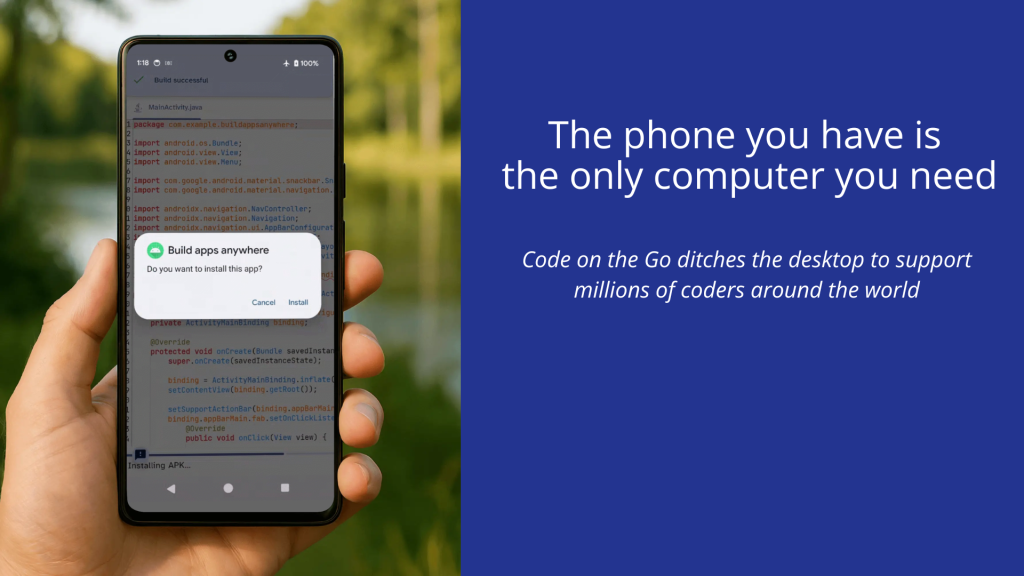
Code on the Go eliminates the need for a second computer when building Android apps, a problem that’s existed for decades in app development. For the hundreds of millions of people worldwide whose only computer is their phone, this isn’t just convenient, it’s what makes Android development possible at all for them.
Welcome to Release 1 of Code on the Go

Gene Roddenberry, creator of Star Trek, imagined a world where technology helped humans reach their full potential, and where everyone had access to the tools they needed to learn, solve problems, and grow. At App Dev for All, I chose this optimistic vision as our guide. Today, on behalf of our team, I am proud to offer Release 1 (R1) of Code on the Go.
Release 1 Goals for Code on the Go

Release 1 of Code on the Go brings core IDE features like full Kotlin language support, a graphical Git interface, a stronger plugin system, and improved UI layouts to a phone-based Android development environment. The update focuses on making serious Android app development practical on a phone, while adapting to different hardware setups such as tablets, external monitors, and limited connectivity.